
Hip Labral Tear Rehabilitation: What to Expect
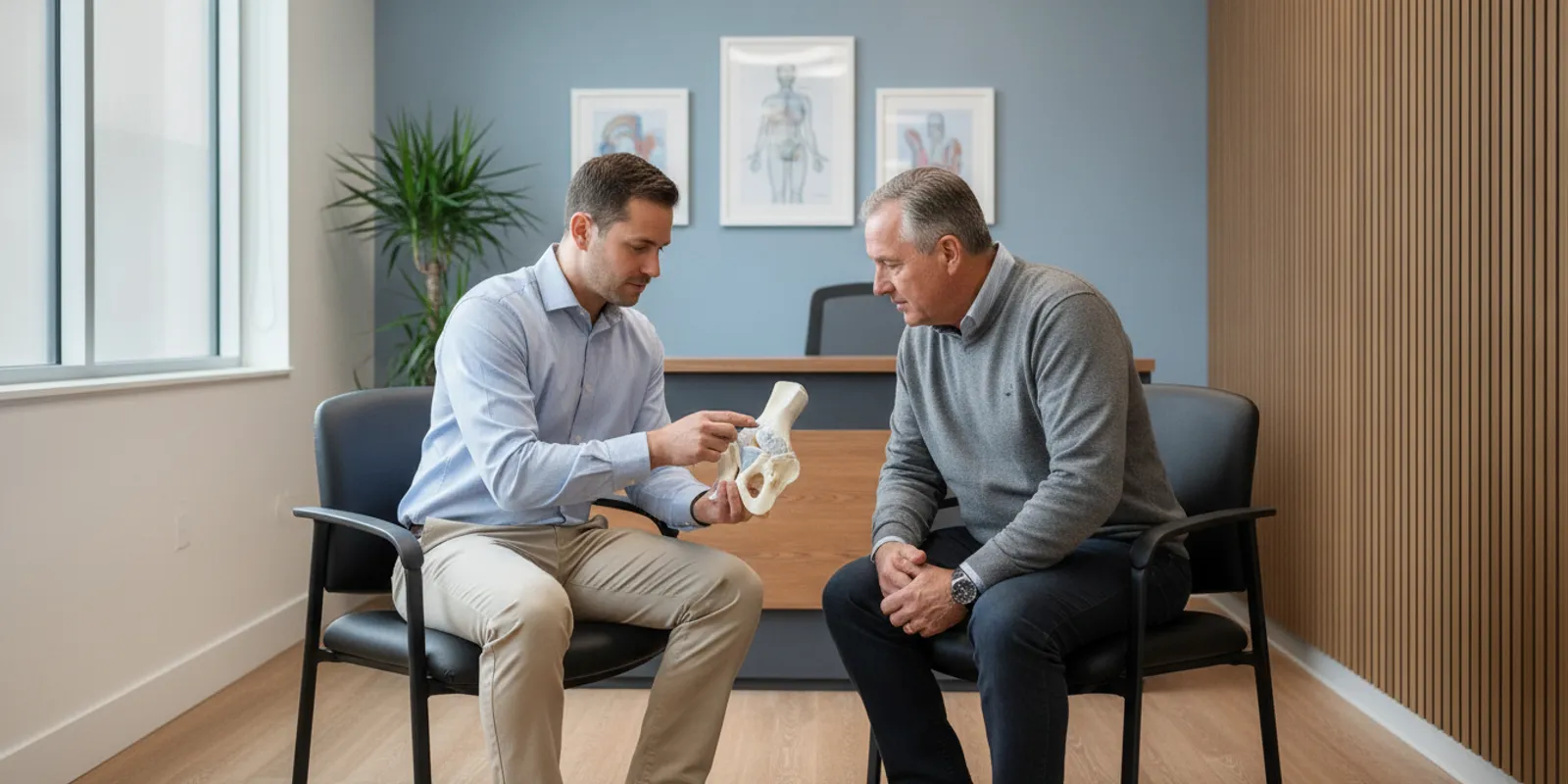
Rehabilitation for hip labral tear concerns is not a one-size-fits-all plan. A clinician may consider a person’s symptoms, examination findings, imaging, health history, and daily movement goals before discussing whether rehabilitation is appropriate. Understanding that process can help you ask useful questions and make decisions without assuming that a scan or a particular treatment tells the whole story.
Explore care options and request a Free Consultation
What is a hip labral tear?
The hip is a ball-and-socket joint. The rounded top of the thighbone, or femoral head, sits in the socket of the pelvis. A ring of firm cartilage called the labrum follows the rim of that socket. It helps deepen the socket and contributes to the joint’s stability and smooth movement.
A labral tear is a change or disruption in that cartilage. It can be associated with an injury, repeated loading, the shape of the hip joint, or changes that occur over time. The term describes a finding; it does not, by itself, explain how much discomfort someone should feel or what care is needed. Some people have a labral finding on imaging without symptoms that clearly come from it. Other people have hip or groin symptoms for which a labral tear is one possibility among several.
That distinction matters. Pain around the hip may also relate to nearby muscles or tendons, the lower back, other parts of the joint, or a different health issue. A scan result should be interpreted alongside the history and physical examination, rather than treated as a complete answer on its own.
What symptoms may lead someone to seek an evaluation?
People with a suspected labral tear may report discomfort deep in the front of the hip or groin. Some describe stiffness, a catching or clicking sensation, or discomfort with particular positions or activities. Symptoms can vary. A click is not proof of a tear, and a tear on imaging does not automatically mean that every sensation comes from the labrum.
It can help to notice the pattern without trying to diagnose it yourself. For example, consider whether symptoms came on suddenly or gradually, whether they change with sitting, walking, stairs, turning, or sport, and whether they interfere with sleep or routine tasks. Record what makes symptoms better or worse, but do not repeatedly test a painful movement to see what happens.
Share whether the hip feels unstable, whether you have had a fall or other injury, and whether symptoms are changing. Include relevant health conditions, prior procedures, medicines, and previous care. This context helps a clinician decide what needs assessment and whether additional evaluation is appropriate.
When should symptoms receive prompt attention?
Seek prompt medical advice after a significant injury, if you cannot put weight on the leg, or if there is sudden severe pain or a major change in function. Fever, a hot or visibly swollen joint, a new area of numbness or weakness, or other symptoms that feel urgent also warrant timely professional guidance. If symptoms are severe or rapidly worsening, use urgent or emergency services as appropriate.
These signs do not identify a particular diagnosis. They are reasons not to rely on a routine rehabilitation appointment as the only next step. When you are unsure how quickly to seek care, contact a qualified healthcare professional or local urgent-care service for advice.
How does an evaluation for a hip labral tear work?
An evaluation typically starts with a conversation. A clinician may ask when symptoms began, what was happening at the time, which activities are affected, and how the problem has changed. They may ask about previous hip or back conditions, injuries, medical history, and what you hope to return to doing. Be specific about practical goals, such as getting through a workday, walking for exercise, or managing stairs, rather than only naming a sport or a diagnosis.
The physical examination may include observation of posture and walking, assessment of hip movement, and checks of strength, balance, or nearby areas. A clinician may use carefully chosen movements to see whether they reproduce symptoms. These checks can contribute information, but no single movement should be treated as a stand-alone confirmation of a labral tear. Tell the clinician if an examination maneuver is painful, and ask what a test is intended to assess.
A clinician may review existing imaging or decide whether further assessment is needed. X-rays and magnetic resonance imaging answer different questions, and the appropriate choice depends on the clinical situation. Imaging findings need interpretation in context: they may contribute to a diagnosis, but they do not measure a person’s ability to move or establish the right care plan by themselves.
If the source of symptoms is uncertain, or if findings suggest that another condition should be considered, the next step may be a discussion with a physician or another qualified specialist. An evaluation is an opportunity to decide what information is missing and whether rehabilitation is suitable, not a commitment to a particular treatment.
What else can shape the evaluation?
The hip does not work in isolation. A clinician may ask about the back, pelvis, leg, and general health because symptoms in nearby areas can overlap or affect movement. This does not mean that a problem elsewhere is necessarily the cause. It means that looking beyond one structure can help make the assessment more complete and avoid assuming that every symptom comes from an imaging finding.
Previous injuries, operations, activity changes, and health conditions may affect which questions or tests are useful. Tell the clinician about relevant history even if it seems unrelated at first. If you take medication or have a condition that affects balance, strength, sensation, or activity tolerance, mention it. Do not stop or change prescribed medication in response to an online article; discuss questions with the professional who manages it.
It can also help to explain how the problem affects you beyond the joint itself. For instance, disrupted sleep, difficulty completing household tasks, or concern about falling may be important to the overall conversation. These details are not proof of a particular cause, but they describe the real impact of the problem and can help shape reasonable priorities for assessment.
Some appointments may not resolve every question at once. A clinician may need to review records, compare imaging with the examination, or arrange another opinion before recommending a path. Ask what is known now, what remains uncertain, and what the next step is intended to clarify. If you leave without understanding the plan, request a concise explanation or a follow-up discussion. Clarity about uncertainty is more useful than a quick but unsupported answer.
What does rehabilitation aim to address?
When rehabilitation is considered, the goals are usually linked to a person’s function and tolerance for daily activity. Depending on the evaluation, a clinician may discuss ways to support comfortable movement, strength, coordination, confidence with routine tasks, or a gradual return to valued activities. Which aims make sense depends on the person and the findings. A rehabilitation plan does not promise that a labral tear will change on imaging or that symptoms will resolve.
It is useful to distinguish a movement goal from a guarantee. A goal might be to find out whether a person can complete a particular everyday task with less difficulty, or to build capacity in a way that is appropriate to their situation. Progress can vary, and symptoms may fluctuate. If a proposed goal does not match your priorities, tell the clinician so that the discussion can be adjusted.
A thorough plan also considers the whole person. Sleep, work demands, other health concerns, confidence with movement, and the ability to attend appointments can affect how practical a care plan is. Discuss these factors openly. The most useful recommendation is one that is medically appropriate and realistic for your life.
What does a careful discussion of care look like?
Before choosing a treatment, make sure the clinician has understood the problem you want help with. Describe what you can and cannot do, how symptoms affect your routine, and what matters most to you. A person hoping to walk comfortably through the neighborhood may define success differently from someone trying to return to a physically demanding job. Both perspectives belong in the conversation. The clinician can help determine which priorities are appropriate to address and whether additional evaluation is needed first.
Ask for the reasoning behind each recommendation. A useful explanation connects the proposed approach to information from your history and examination, identifies what remains uncertain, and describes how the plan might be reviewed. If a recommendation is based on a scan, ask how that finding matches your symptoms and whether other explanations remain possible. If it is based on movement or strength findings, ask what those findings suggest and what they cannot establish. This makes it easier to understand the purpose of a plan without treating any one test as definitive.
Care should also account for the demands of participation. Tell the clinician about work schedules, transportation, caregiving responsibilities, other appointments, and any barriers that could make a plan difficult to follow. Ask what the expected time commitment is and whether options can be adapted to your circumstances. A plan that sounds comprehensive but does not fit your daily life may not be practical. Discussing feasibility is part of making an informed decision, not a lack of commitment.
Find out how communication will work. Ask whom to contact if symptoms change, if you have a question about a recommendation, or if you are unsure how to respond to a new problem. Clarify when a routine follow-up is appropriate and what kinds of changes deserve quicker attention. If more than one clinician is involved, ask how information will be shared and who is coordinating the next step. Clear responsibility can help prevent contradictory advice or gaps in follow-up.
It is also reasonable to ask about the limits of rehabilitation. A clinician should not promise that a particular program will repair a tear, guarantee a return to a specific activity, or produce a fixed outcome by a certain date. The focus of a rehabilitation discussion is how care may support function in your circumstances, while recognizing that responses differ. If symptoms do not change as expected, the plan may need review, or another explanation may need consideration. Ask what the next decision point would be rather than assuming the same approach should continue indefinitely.
Keep a brief record of changes if it helps you communicate. You might note which daily tasks were easier or harder, whether symptoms changed after usual activities, and any new concerns. The record does not need to be technical or exhaustive. It is a way to give a clinician specific examples at follow-up. Avoid repeatedly testing the hip or making abrupt changes solely to collect information; ask the clinician what observations are useful and how to make them safely.
Finally, you can take time to decide. Ask for written information or a summary of the options, and make sure you understand any financial commitment before agreeing to services. You may ask another qualified clinician for an opinion, especially if the diagnosis or proposed next step is unclear. A respectful discussion leaves room for questions and acknowledges that choosing care is a shared process informed by clinical judgment and your preferences.
How may a rehabilitation plan be tailored?
A clinician may first consider how irritable the symptoms are and which movements or tasks currently feel manageable. They may then discuss a starting point and how to monitor the response. The specifics should come from an individual assessment; a generic online routine cannot account for the cause of symptoms, examination findings, or other conditions.
As the discussion continues, the clinician may consider how to address movement patterns, strength, control, or tolerance for activity. The order and emphasis can differ. A person who is struggling with basic daily tasks may have different priorities from someone whose main goal is to resume a demanding activity. Any changes should be guided by how the person responds and by the clinician’s assessment.
Rehabilitation can involve learning, practice, and review over time. A clinician may explain how to notice a meaningful response, when to modify an activity, and what to do if symptoms increase. Ask how the plan will be reviewed and what would lead to a change in approach. The purpose of these conversations is to make care understandable and responsive, not to follow a fixed sequence regardless of how you feel.
Do not assume that a more difficult activity is automatically better or that discomfort should be pushed through. Ask your clinician what sensations are expected in your particular plan and which changes should prompt you to stop and seek guidance. If symptoms become substantially worse, new symptoms appear, or function declines, report that rather than simply adding more activity.
What movement goals might matter?
Useful goals are concrete, meaningful, and suited to the person’s circumstances. Examples to discuss—not exercises to start on your own—might include managing a normal day of household tasks, moving between sitting and standing, walking on a chosen route, or returning to a recreational activity. A goal can also focus on understanding which activities are manageable while the hip is being evaluated.
It may help to describe the goal in practical detail. Instead of saying only “I want my hip to be better,” explain what you want to do, how often, and what currently gets in the way. You might say that you want to shop without needing frequent rests, feel more confident on stairs, or participate in a specific activity at a level that matters to you. The clinician can help determine whether that aim is suitable and how to assess it.
Goals can be revised. A person’s priorities may change as they learn more, and a clinician may recommend a different starting point after reviewing symptoms or test results. Revising a goal is not a failure; it is part of making a plan fit the available information and the person’s needs.
What if a scan has already shown a tear?
Bring the report and, if available, the images or instructions for accessing them. Ask the clinician to explain the finding in plain language: where it is, what the report can and cannot establish, and whether it matches your symptoms and examination. A scan is one part of an assessment, not a complete forecast of pain, function, or response to care.
It is reasonable to ask whether other findings were noted and whether they change the discussion. Also ask what would make the team reconsider the working explanation. These questions can clarify uncertainty without treating an imaging report as meaningless or assuming it tells the whole story.
If someone recommends a specific treatment mainly because the scan uses the word “tear,” ask how that recommendation connects to your symptoms, goals, and examination. You can request time to consider the explanation, seek another qualified opinion, or ask what alternatives are appropriate. A clear plan should include a reason for the recommendation and a way to review whether it remains suitable.
How do nonsurgical care and surgery fit into the discussion?
There is no single route that is right for every person with a labral finding. Depending on symptoms, examination, imaging, overall health, and goals, a clinician may discuss activity adjustments, rehabilitation, further evaluation, or a referral to an orthopedic specialist. A surgical consultation can help explain options; it does not mean surgery is required.
If surgery is raised, ask what problem it is intended to address, what findings support considering it, what alternatives may be appropriate, and what the likely recovery demands would be in your circumstances. Ask about limitations, risks, follow-up, and how other health conditions could affect planning. A surgeon is best placed to explain the potential benefits and risks of a procedure for your case.
If rehabilitation is discussed, ask how the plan will be coordinated with any other care and what would prompt a reassessment. If a recommendation is not clear, it is appropriate to request an explanation in plain language. Decisions should reflect the full clinical picture and your informed preferences, rather than a promise of a particular result.
How can you compare care options?
Compare recommendations by asking the same practical questions of each clinician. Focus on the reason for the proposed approach, how it relates to your assessment, what you would be asked to do, and how the plan would be reviewed. A confident promise is not a substitute for a clear explanation of uncertainty, risks, and alternatives.
- Reason: What findings support this recommendation, and what other explanations have been considered?
- Fit: How does the plan relate to the activities I want to manage?
- Options: What reasonable alternatives are available, including further evaluation or a referral?
- Monitoring: How will we decide whether the approach is appropriate, and what should I report?
- Practical details: How often would visits be considered, what participation is expected, and what are the financial arrangements?
- Coordination: Who should I contact if symptoms change or I have questions between visits?
For cash-pay care, request a clear explanation of any proposed services and their costs before making a decision. Do not assume that a particular service is covered by insurance. Ask what is included, whether additional appointments or services could involve separate charges, and what choices are available if the plan is not a fit. You should have a chance to understand the commitment before agreeing to proceed.
How can you prepare for an appointment?
A little preparation can make the time more useful. Write down a short timeline and the activities affected. Bring relevant imaging reports, prior evaluation notes, and a list of medicines and major health conditions. If another clinician has been involved, note what was assessed and what recommendations you received.
Before the visit, choose two or three functional priorities. Think about what you most want to understand: whether the hip finding fits your symptoms, what other causes might be considered, whether a rehabilitation discussion makes sense, or when further evaluation may be needed. You do not need to arrive with a diagnosis or a complete treatment plan.
During the appointment, take notes or ask whether you may bring someone to help remember the discussion. Request explanations for unfamiliar terms. If you are not ready to decide, ask what information you can review afterward and whether there is a reasonable timeframe for follow-up. An informed choice is more useful than agreeing because you feel rushed.
What should you ask about rehabilitation for hip labral tear concerns?
Consider bringing questions such as these to an evaluation:
- What are the possible explanations for my symptoms, and how certain is the working assessment?
- How do my examination findings and any imaging relate to one another?
- Is rehabilitation a reasonable option in my situation? If so, what are the initial functional goals?
- How will we decide whether the approach is appropriate for me?
- Which changes in symptoms should I report promptly?
- When might additional imaging, a specialist referral, or another opinion be useful?
- What are the expected time, participation, and financial commitments?
- Who should I contact if I have a concern between appointments?
Answers may depend on information gathered during the examination. It is reasonable for a clinician to explain what is not yet known and what could help clarify it. The goal is a shared understanding of the options and their limits, not a guarantee about how the hip will respond.
Frequently asked questions
Does a hip labral tear always need surgery?
No single answer applies to everyone. The decision depends on symptoms, clinical findings, health history, and personal goals. A clinician may discuss rehabilitation, further assessment, a specialist opinion, or other options. Ask how each recommendation relates to your situation and what alternatives are appropriate.
Can a rehabilitation evaluation confirm that I have a labral tear?
A rehabilitation evaluation can assess movement and function, but a physical examination alone does not necessarily confirm a labral tear. A qualified clinician considers the history, examination, and any relevant imaging or other tests. Ask who is making the diagnosis and whether additional assessment is needed.
Does a tear on an MRI mean it is causing my symptoms?
Not by itself. Imaging can provide useful information, but its findings should be interpreted with symptoms and examination results. Ask the clinician to explain how the scan fits the rest of the evaluation and whether other causes should be considered.
Should I keep doing activities that cause discomfort?
Do not use a general online rule to decide what is safe for you. Ask a qualified clinician how to approach the activities that matter to you and what changes should prompt you to modify them or seek reassessment. Sudden severe symptoms or a major change in function deserves prompt attention.
Where can I learn more about hip and joint health?
For general health information, you can explore the National Institutes of Health. General information cannot determine the cause of your symptoms or replace an individual assessment.
Review available services and request a Free Consultation
Talk through your questions at a consultation
A hip labral finding is one piece of information, not a complete account of your movement or a prescription for a particular treatment. A careful discussion can connect your symptoms, evaluation, and day-to-day goals, then clarify whether rehabilitation or another next step may be appropriate. Bring your questions and ask for recommendations to be explained in a way that helps you make an informed choice.