Gait Training and Rehabilitation: Supporting Mobility Goals
Walking can become less predictable for many reasons: a change in balance, discomfort, weakness, altered sensation, or a period of reduced activity. Gait training as part of physical medicine and rehabilitation is an approach that may help a person and their care team understand walking challenges and discuss practical mobility goals. The first step is not assuming one cause or choosing a standard exercise plan. It is describing what has changed and asking what kind of evaluation is appropriate.
Explore care options and ask about a free consultation
What does gait training in rehabilitation mean?
Gait is the pattern of movement used when walking. Gait training is a broad term for care focused on walking ability, which may include looking at how someone moves, identifying barriers to safe and comfortable mobility, and discussing ways to work toward functional goals. The details depend on the individual’s health history, current abilities, and the reason walking has changed.
A gait-focused conversation is not simply about making each step look a certain way. Walking matters because it connects with daily life: moving around the home, getting to a vehicle, crossing a room, standing in line, or enjoying an outing. A useful plan takes the person’s priorities into account rather than treating one movement pattern as the only measure of progress.
Gait training is one part of rehabilitation. The term does not mean every person will receive the same assessment or follow the same treatment. Some people may need further medical assessment before a rehabilitation plan is considered. Others may be discussing a gradual return to activity after a period of limited movement. A qualified clinician can help determine which next step fits the situation.
Why might walking change over time?
Walking depends on more than the legs moving forward. It involves coordination, balance, strength, sensation, joint movement, vision, attention, and the ability to respond to the walking surface and surroundings. A change in any one of these areas can affect how confident or steady a person feels. More than one factor may be involved, so it is best not to conclude the cause based on a single sign.
People may notice that they walk more slowly, take shorter steps, avoid uneven ground, hold onto furniture, or need extra time to turn. Some may feel hesitant on stairs or in crowded places. Others may report fatigue or difficulty walking for the distance they used to manage. These observations are useful to share, but they do not establish a diagnosis on their own.
Discomfort, reduced activity, a previous injury, a health condition, medication effects, or changes in sensation can all be relevant topics for a clinician to consider. This list is not a way to self-diagnose. If walking has changed, especially if the change is new, worsening, or interfering with daily routines, discuss it with an appropriate healthcare professional.
Consider tracking the circumstances rather than trying to label the problem. Does the change occur indoors or outdoors? Is it more noticeable after sitting, later in the day, or on a particular surface? Does it affect turning, standing up, or walking a longer distance? Concrete examples can help a provider understand the impact and decide what information to gather next.
What may be discussed in a gait assessment?
An assessment generally begins with a conversation about the concern and the person’s goals. The clinician may ask when the walking change began, whether it has changed over time, what makes it easier or harder, and how it affects everyday activities. They may also ask about relevant health history, prior care, medication, falls or near-falls, and any assistive device already being used.
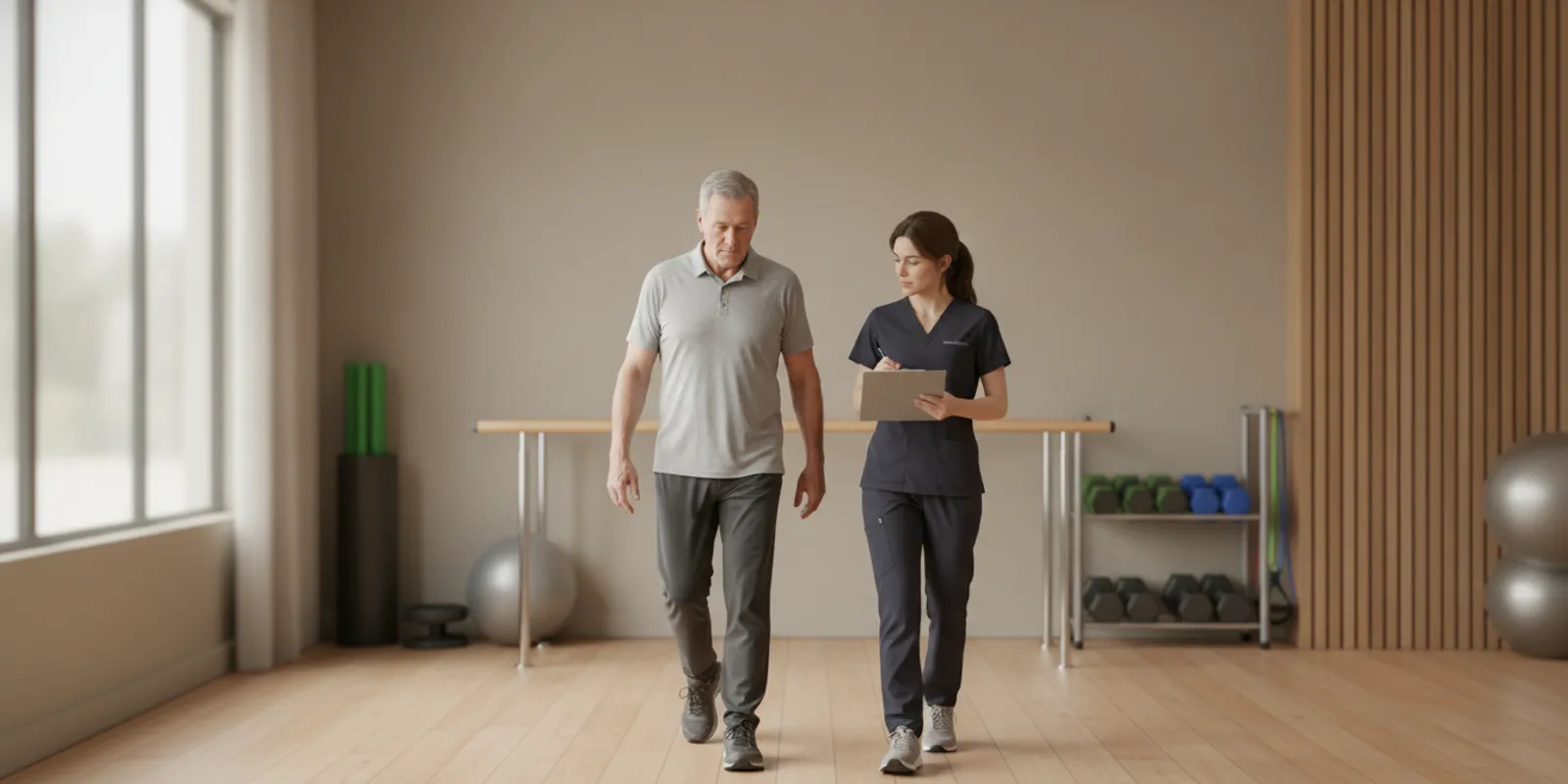
Depending on the situation and the clinician’s scope, an evaluation may include observing a person stand, start walking, walk at a comfortable pace, turn, and stop. The clinician may ask about comfort, confidence, or fatigue during these tasks. They may consider balance, coordination, strength, range of motion, sensation, or how the person responds to different walking conditions. The exact components are not identical for everyone.
Some parts of an evaluation may require additional safeguards or may be deferred if they are not appropriate. The person should be able to say if a task feels unsafe, painful, or too tiring. Questions about why an activity is being assessed are reasonable. A clinician can explain the purpose, offer a modification, or decide that another kind of assessment should come first.
Assessment may also include the environment and the task that matters most to the person. Walking across a clear clinic space is different from navigating a curb, a crowded shop, or the route from a bedroom to a bathroom at night. Describing those real-life settings can help make the discussion more useful. A clinician can determine whether a setting-specific assessment is suitable.
How can mobility goals be made meaningful?
A mobility goal should connect to something the person wants or needs to do. “Walk better” is understandable, but it does not say which daily activity matters most. A more useful starting point might be: “I want to feel steadier walking from my car to the entrance,” or “I want to understand why turning in the kitchen feels difficult.” The clinician can help clarify whether and how that goal can be addressed.
Goals can describe participation, confidence, or a practical task, not just a physical measure. Someone may want to move safely around the home, get to a community activity, manage a familiar route, or resume a valued routine. A goal does not promise that the activity will become easy or that a specific change will happen. It gives the care conversation a shared focus.
It can help to make a goal specific enough to discuss. Instead of “be more active,” explain the activity, the setting, what currently gets in the way, and what a helpful change would look like to you. For example, you might say that you avoid a particular errand because you are unsure how long you can walk or where to rest. That detail lets the clinician ask better follow-up questions.
Goals may need to change as new information becomes available. A care team may suggest beginning with a smaller, safer task or may recommend a medical review before working on a mobility goal. This is not a failure. It is part of aligning the next step with the person’s needs, abilities, and safety considerations.
What factors can shape a gait training plan?
There is no single plan that fits everyone who has difficulty walking. The reason for the change, health history, current mobility, personal goals, and the evaluation findings all matter. The clinician should explain which findings are relevant and what they do—and do not—indicate. If the reason for a recommendation is unclear, ask for it in plain language.
Depending on the evaluation, a care discussion might address movement practice, balance, strength, coordination, walking tolerance, mobility aids, or ways to approach daily activities. These are examples of areas that may be considered, not a menu that everyone should follow. Your clinician determines whether an option is appropriate and how it should be carried out.
Assistive devices, such as a cane or walker, can be part of a mobility conversation for some people. Whether a device is appropriate, and how it should be fitted or used, depends on an individual assessment. Do not assume that copying another person’s device or technique is safe for you. Ask a qualified professional to assess your needs and provide instruction when needed.
Health conditions may require coordination with other members of a care team. A gait concern may warrant evaluation beyond rehabilitation, or a clinician may recommend reviewing medications or other health factors with the professional responsible for that care. A clear plan should explain who to contact, what each person is addressing, and how to follow up if symptoms change.
At Sigma Core Medical Center, care conversations are framed around function, recovery, and individual goals. A consultation can help you ask whether the services available are relevant to your concern; it cannot establish that a particular type of care will be appropriate or produce a specific outcome without an evaluation. You can read more about the center’s services and its approach to neuropathy care before deciding what questions to bring.
How can options be compared without oversimplifying?
When several next steps are being considered, compare what each option is meant to clarify, what it involves, and what questions remain. The table below is a discussion aid, not a treatment recommendation. Your clinician can explain which path makes sense based on your specific circumstances.
| Discussion point | What it may help clarify | Question to ask |
|---|---|---|
| Medical evaluation | Whether a new or changing walking concern needs assessment for an underlying health issue | Should I be evaluated medically before beginning rehabilitation? |
| Rehabilitation assessment | How walking and related functional tasks may be examined, and whether a rehabilitation plan is suitable | What will you assess, and how will my goals shape the plan? |
| Mobility support | Whether an assistive device or a change in the environment could be considered | Would a device be appropriate, and who can show me how to use it? |
| Follow-up or coordination | How to review changes, questions, or recommendations from more than one clinician | Who should I contact if my walking changes or a concern comes up? |
When comparing services, also ask what is included in an evaluation, what the clinician can and cannot determine, and what happens if the service is not a fit. For cash-pay care, ask for the full financial details directly before making a decision. Do not rely on assumptions about insurance coverage or total costs; terms can vary, and the center does not publish a treatment price in this article.
How can you prepare for an appointment?
A few notes can make an appointment more focused. Write down what changed, when you first noticed it, and how it affects activities that matter to you. Include whether the change is stable, improving, or worsening, and whether it happens in particular settings or at particular times. If you have had a fall or near-fall, describe what happened and when.
Bring a list of relevant health conditions, medications, previous evaluations, and questions. If another clinician has already assessed the concern, bring any information you have been asked to share. You do not need to arrive with a diagnosis or technical description. A clear account in your own words is useful.
If you use a mobility aid, mention it when arranging the visit and bring it if appropriate. Wear clothing and footwear that allow you to move comfortably, unless the clinic gives different instructions. If you are concerned about walking from the entrance or completing an assessment, raise that concern before or at the start of the appointment so the staff can discuss a safer arrangement.
It may be helpful to bring a trusted support person if you want help remembering questions or recommendations. The patient should remain at the center of the conversation and should be able to ask questions directly. Afterward, write down the agreed next step, any precautions, and whom to contact if the plan or symptoms change.
When should a change in walking receive prompt attention?
Some walking concerns develop gradually; others appear suddenly. A sudden change in walking, sudden weakness or numbness, trouble speaking, confusion, severe dizziness, or a new inability to coordinate movement can signal an urgent medical problem. Seek emergency medical care right away for sudden or severe symptoms rather than waiting for a routine rehabilitation appointment.
Promptly contact a healthcare professional about a new or worsening difficulty walking, repeated falls, a significant change in balance, or symptoms that interfere with daily activities. If you are unsure how urgent a change is, contact a qualified medical professional or local urgent-care service for guidance. This article cannot evaluate your symptoms or replace individualized medical advice.
It is also important to report a new concern during an appointment, even if it seems unrelated to the original reason for the visit. The clinician can decide whether to continue, modify, or pause an activity and whether another evaluation should happen first. You are entitled to understand the reason for the recommendation and the appropriate next step.
What questions help clarify care choices?
Clear questions can make a discussion more practical. Consider asking:
- What might be contributing to the walking change, and what remains uncertain?
- What will the assessment involve, and how will we adapt it if a task feels unsafe?
- What is the purpose of the recommended care, and how does it connect to my daily goals?
- Are there reasons to seek medical evaluation before beginning rehabilitation?
- How will we review whether the plan is appropriate for me?
- What should I do if my symptoms change, or if an activity feels worse?
- Are there other professionals I should consult or coordinate with?
- What are the financial terms, and what is or is not included?
It is reasonable to ask for an explanation of unfamiliar terms or to take time to consider a recommendation. A thoughtful care conversation should make space for questions, explain uncertainty, and avoid promising a particular outcome. You can also discuss what matters most to you—independence, confidence, comfort, or participation in a valued activity—so the next step is not defined by a generic goal.
Frequently asked questions
Is gait training only for people who use a walker?
No. A gait concern can be discussed whether or not someone uses an assistive device. Whether a device is needed is a separate question for an appropriate assessment. If you already use one, mention it to the clinician and ask whether its fit and use should be reviewed.
Does a gait assessment always include walking tests?
Not necessarily. What an evaluation includes depends on the person’s situation and what the clinician determines is appropriate. The clinician may begin with a conversation, observe certain movements, adapt an activity, or recommend another evaluation first. Ask what each part is intended to assess and speak up if you feel unsafe.
Can gait training address balance and daily mobility together?
Balance and mobility may be relevant to a gait-focused discussion, but the right priorities depend on an individual assessment. Describe the tasks that feel difficult and ask how they relate to your goals. A clinician can explain which concerns may be addressed and whether another professional should also be involved.
How long does it take to see a change?
There is no reliable timeline that applies to everyone. Progress and the course of care depend on the reason for the walking change, overall health, and other individual factors. A clinician can discuss how follow-up will work, what will be reviewed, and when to reconsider the plan. No particular result or time frame should be assumed.
Should I start gait exercises I find online?
Do not assume an exercise is safe or appropriate just because it appears in a video or article. Walking and balance concerns can have different causes, and an activity that suits one person may not suit another. Ask a qualified professional to assess your situation before beginning an exercise plan, especially if your walking has recently changed or you feel unsteady.
Learn about care options and discuss your mobility questions
Walking concerns deserve a careful, individualized conversation focused on safety and the activities that matter to you. Share what has changed, ask what an evaluation can clarify, and work with a qualified healthcare professional to decide on an appropriate next step.